

Sustainable urban living programme
Information
Helsinki Region Environmental Services Authority
4.2.2022
Sustainable urban living programme
Helsinki Region Environmental Services Authority HSY
P.O.BOX 100
00066 HSY
tel. +358 9 1561 2110
www.hsy.fi
Circular economy measures for construction range from land masses and landscaping to building construction
Vision: Buildings are used in a space efficient and energy saving manner. Good maintenance supports sustainable use, extends the life cycle of buildings, and building elements and materials circulate efficiently. Land masses are optimised and the use of recycled materials in construction is commonplace. Functional and comprehensive green structures safeguard biodiversity and the functioning of ecosystem services.
The Helsinki Metropolitan Area is one of Finland’s most significant focus areas for new construction, and the region’s cities will continue to grow strongly. In addition to material efficient new construction, sustainable urban living relies heavily on the renovation of the existing building stock. In terms of new construction and renovation, the development of the metropolitan area is also of great importance nationally, as the new policies and criteria applied in the area to support sustainability and the circular economy can be seen as developing the entire construction sector – the availability of solutions will improve and their cost level will decrease as the demand for new methods based on the circular economy increases.
When materials and building elements are reused, the environmental load from the manufacture of new ones is avoided. For this reason, new resources are needed to manage and plan the use of recyclable and reusable materials and building elements or masses in order to put the circular economy into practice.
Sustainable urban living in 2030:
- The sharing and communal use of facilities helps to utilise the existing building stock more efficiently, reducing the pressure for unnecessary additional construction.
- Regional cooperation supports and encourages improving the energy efficiency of residential buildings.
- The cities and regional actors work together to guide the implementation of key circular economy practices in the construction industry, which will form an integral part of high-quality construction for a sustainable outcome.
- Mass economy planning and coordination is being developed in earthworks and infrastructure construction at the local and regional level.
- Diverse solutions of the green infrastructure promote biodiversity and are a visible part of the day-to-day life of the city structure.
Objective: Increasing the efficiency and functionality of buildings during use and strengthening the impact of measures to support the circular economy in the construction of the area through regional policies and cooperation.
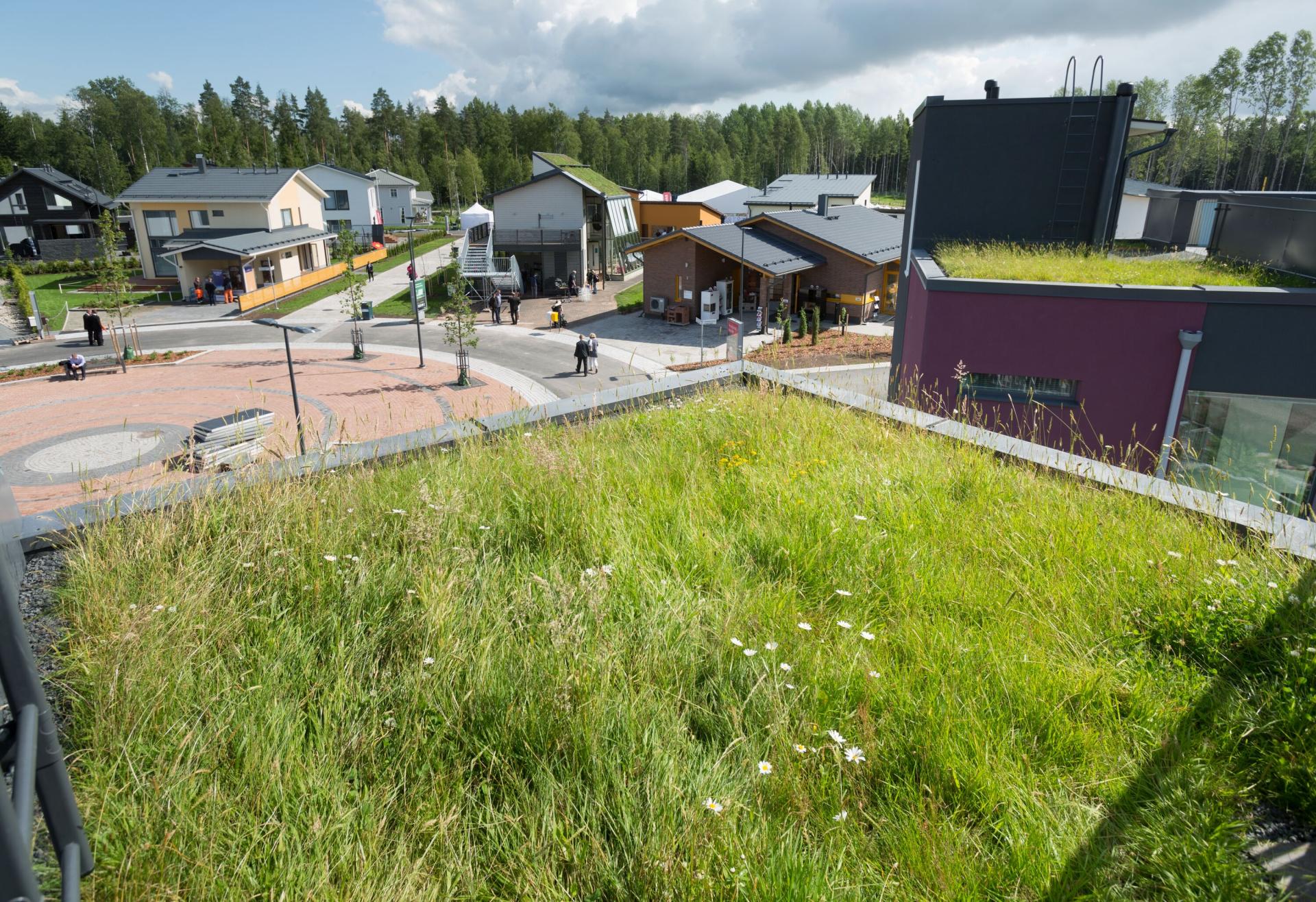
Sustainable construction is followed by energy and material efficient building use
Measures in which HSY may be involved as one actor
Measure 51. Intensifying circular economy cooperation in regional construction
Measure 52. Encouraging energy renovation of residential buildings in the region
Measure 53. Developing coordination of the reuse of building and demolition elements in the region
Measures proposed by HSY to other actors (policies)
Measure 54. Promoting space efficiency and communality
Measure 55. Looking into better utilisation of existing buildings
Measure 56. Utilising building materials from demolished buildings
Measure 57. Increasing adaptation information in construction
Measure 58. Guiding the region’s construction with circular economy examples
Measure 59. Increasing consideration of circular economy aspects in construction design
The power of regional cooperation in earthworks and infrastructure construction
Measures in which HSY may be involved as one actor
Measure 60. Optimising mass economy in earthworks and infrastructure construction
Measures proposed by HSY to other actors (policies)
Measure 61. Increasing circular economy guidance in infrastructure construction
Green infrastructure for comfort and many other benefits
Measures in which HSY may be involved as one actor
Measure 62. Piloting urban retrofitting
Measure 63. Piloting a plot-specific green factor at renovation sites
Measure 64. Promoting the construction of urban gardens, vegetated roofs and walls