

Sustainable urban living programme
Information
Helsinki Region Environmental Services Authority
4.2.2022
Sustainable urban living programme
Helsinki Region Environmental Services Authority HSY
P.O.BOX 100
00066 HSY
tel. +358 9 1561 2110
www.hsy.fi
Designing a carbon neutral and healthy city
Vision: Carbon neutrality, the circular economy and the pursuit of sustainable living are the cornerstones of urban planning. Day-to-day life in the growing region is sustainable, healthy and safe. The community structure is integrated and based on sustainable mobility connections. Walking and cycling, as well as the use of rail and other public transport, are appealing and smooth. Housing is energy efficient and the built environment provides good conditions for its users, also taking into account adaptation to climate change. Services are based on sustainable consumption and the circular economy. The service structure is versatile and focused on sustainable mobility nodes. Basic services are easily accessible with sustainable forms of mobility and green areas are a safe walk away for everyone.
Our built environment is constantly evolving and the strong growth of the Helsinki Metropolitan Area will continue to put pressure on new dwellings, jobs and services, as well as on the quality of the green environment. Urban planning plays a key role in creating the conditions for low-emission trip chains, sustainable services, carbon neutral properties and functionally mixed residential and workplace areas in the cities.
The energy consumption of buildings as well as transport are the largest sources of greenhouse gas emissions in the region’s cities, and making these functions carbon neutral is also a huge challenge for urban planning. In addition to reducing greenhouse gas emissions, urban planning that aims for carbon neutrality often also reduces emissions that degrade air quality, which improves the air quality and promotes the healthiness and comfort of the living environment. Alongside climate change mitigation, new means to adapt to and prepare for the effects of climate change are also needed. Urban planning also creates the conditions for maintaining and improving the quality of life of city residents as well as biodiversity. At the same time, attention can be paid to the ability of green areas and the built environment to sequester and store carbon, which is important for achieving carbon neutrality targets.
Sustainable urban living in 2030:
- Urban planning is used to guide regional energy efficiency and the realisation of a carbon neutral built environment.
- Carbon neutral and functionally mixed residential and workplace areas located in sustainable mobility zones, especially in rail transport station areas, contribute to the realisation of sustainable urban living.
- Maintaining the circular economy is one of the starting points for urban planning.
- New good practices are being discovered for climate change adaptation.
- The negative effects of social segregation are being curbed and the built environment supports everyone’s opportunities for sustainable and healthy urban living.
Objective: Carbon neutral and functionally mixed residential and workplace areas serve as an example of coordinating the promotion of the circular economy as well as the mitigation and adaptation to climate change in the urban area.
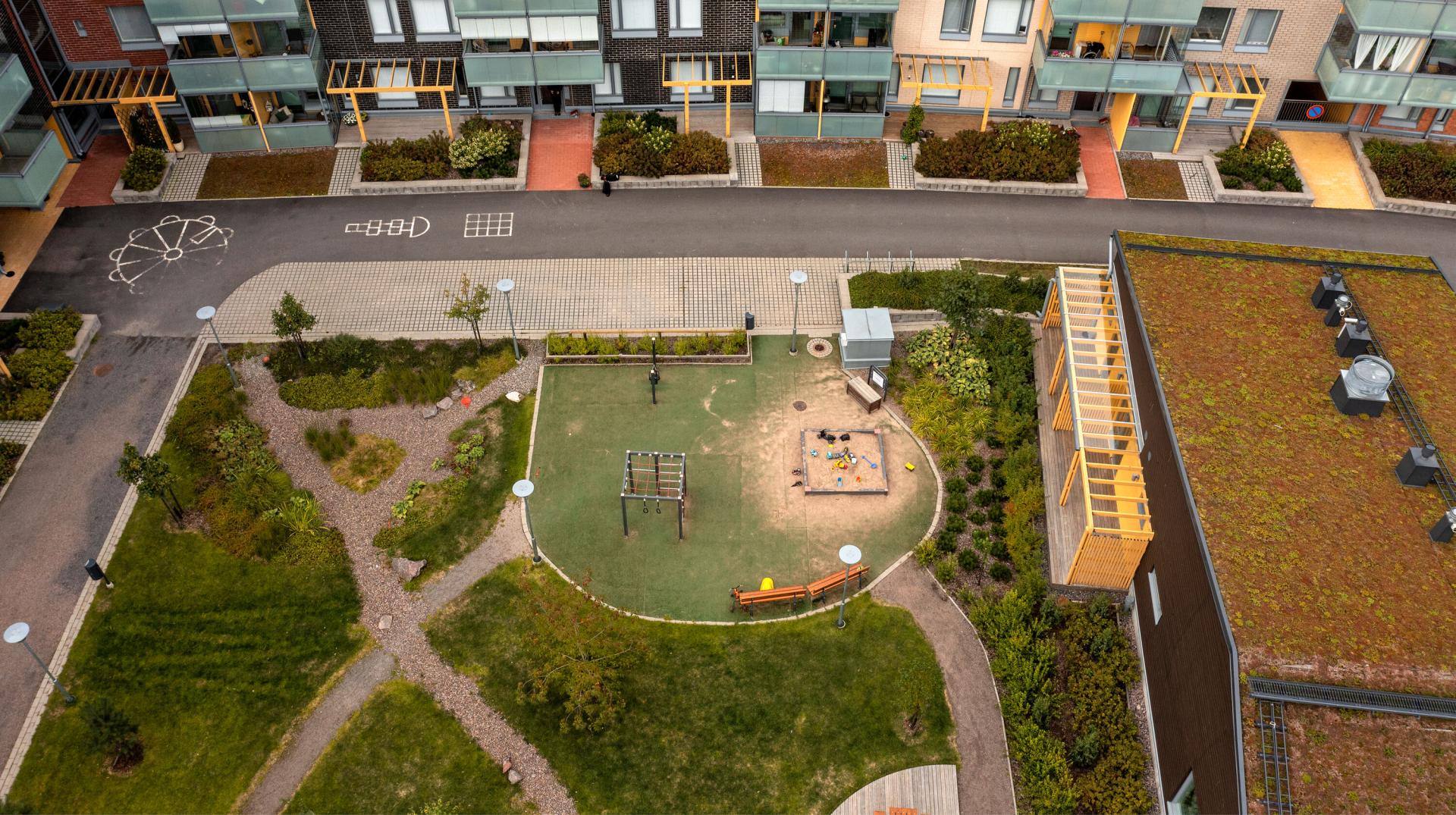
Sharing know-how in the development of carbon neutral areas - the next step in regional cooperation
Measure 41. Introducing best practices for the planning and construction management of carbon neutral areas
Measure 42. Intensifying cooperation in the development of carbon neutral station areas in the Helsinki metropolitan area
Measure 43. Strengthening understanding of the promotion of the circular and sharing economy in planning
Responding to the new information needs of carbon neutral urban planning
Measure 44. Deepening knowledge of mobility and transport and utilising it in the development of a sustainable urban environment
Measure 45. Creating a data pool on carbon sinks and storages in the Helsinki metropolitan area
The built environment adapts to the effects of climate change
Measure 46. Mapping and developing the green and blue infrastructure in the Helsinki metropolitan area
Measure 47. Improving the separation of permeable and impermeable surfaces in the Helsinki metropolitan area in datasets by means of remote sensing
Measure 48. Implementing urban heat island modelling and scenarios
Measure 49. Strengthening network cooperation on adaptation to climate change
Measure 50. Accelerating the introduction of nature-based solutions