

Sustainable urban living programme
Information
Helsinki Region Environmental Services Authority
4.2.2022
Sustainable urban living programme
Helsinki Region Environmental Services Authority HSY
P.O.BOX 100
00066 HSY
tel. +358 9 1561 2110
www.hsy.fi
Enabling the circular economy through innovative waste management and water services
Vision: The amount of waste generated is low, and the waste that is generated is sorted efficiently and recovered in the best possible way. Water services are implemented in an energy-efficient manner, water is consumed smartly while minimising environmental impacts.
The transition to a circular economy requires minimising the amount of waste at all stages of production. The amount of waste is best reduced at the system level in production and through product design, and at the personal level through consumption choices. The EU Waste Framework Directive has set a recycling target of 60% for municipal waste by 2030. HSY is aiming for a recycling rate of 60% in the Helsinki Metropolitan Area already by 2025. Municipal waste is defined as waste from people’s consumption in homes as well as in public and private services.
Many industries are working hard to promote the circular economy and material recycling. Companies play an important role in the piloting and development of innovative business models, processes, products and services. Cities, in turn, have a key role to play in enabling innovative circular economy business. Achieving these objectives requires regional cooperation, a common goal, coordination and information, as well as new types of products and services that help reduce waste volumes.
This chapter aims to improve the efficiency of the circular economy mainly through innovative waste management and water services. Measures related to consumption (Chapter 3), food (Chapter 4) and construction (Chapter 7) also contribute to the achievement of waste reduction targets. Unlike the other priorities of the programme, the objectives of this priority are aimed already at the year 2025 in accordance with HSY’s strategy.
Sustainable urban living in 2025:
- Encouraging efficient waste sorting to increase the recycling rates of municipal and household waste to 60%, and so that 60% of biowaste is recovered through separate collection.
- Reducing the amount of plastic in mixed household waste to half of the 2018 level.
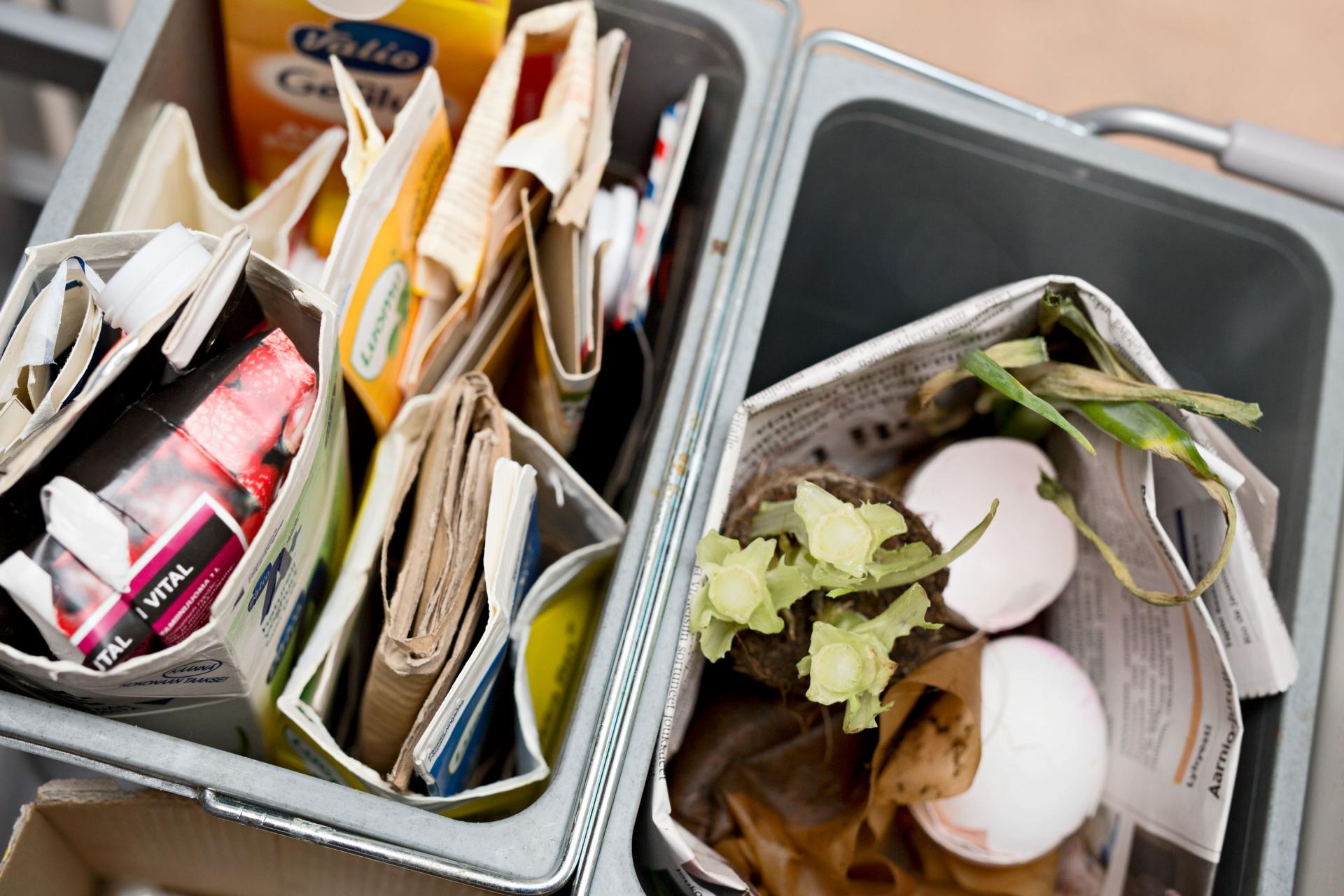
Encouraging efficient sorting of municipal waste
Measure 24. Developing waste management costs and collection solutions to encourage recycling
Good, bad plastic – the place of plastic in a low-carbon circular economy
Measure 25. Developing plastic collection, recycling and reuse
Measure 26. Increasing understanding of the benefits and disadvantages of plastic
Measure 27. Favouring products made of recycled plastic over virgin plastic in public procurement
Enabling nutrient and carbon cycles – biomasses and sludges
Measure 28. Introducing new ways to promote the sorting of biowaste by residents
Measure 29. Increasing biomass recycling in the Helsinki metropolitan area
Measure 30. Utilising recycled fertilisers and biomasses locally, safely and flexibly
Measure 31. Identifying the most beneficial uses for biochar
Energy efficient water services in line with the circular economy
Measure 32. Looking into innovations in wastewater treatment and ensuring the nutrient cycling in wastewater
Measure 33. Reducing energy consumption and increasing renewable energy production
Measure 34. Strengthening the operating conditions for regional alternatives to wastewater heat recovery
Measure 35. Developing and introducing new innovations to minimise clean water consumption
Circular economy and industrial centres as accelerators of sustainable solutions
Measure 36. Identifying and strengthening circular economy business ecosystems in the Helsinki metropolitan area
Measure 37. Investing in the pretreatment of waste in plant conditions
Measure 38. Introducing new and safe uses for ash and slag from waste incineration
If you can’t measure it, you can’t manage it – regional circular economy indicators
Measure 39. Preparing new circular economy indicators and developing waste statistics
Measure 40. Improving the knowledge of city residents about the amount of waste they produce