

Consumption-based emissions for municipal planning
Information
Helsinki Region Environmental Services Authority
9.3.2021
Helsinki Region Environmental Services HSY
PO Box 100, FI-00066 HSY
Phone: +358 9 1561 2110
www.hsy.fi
Photos: HSY / Kai Widell
Abstract / Tiivistelmä

Abstract
While cities contribute widely to the global greenhouse gas (GHG) emissions and hence to climate change, they can also be important actors in reducing these emissions. In order to effectively set GHG reduction targets and to monitor progress towards them, it is essential to regularly keep track of city-level emissions and climate impacts of consumption.
This report presents a short overview of how cities and municipalities have accounted or can account for consumption-based emissions within their respective areas in addition to more traditional territorial or production-based emissions accounting. The report has been produced as a cooperation between the EIT Climate-KIC Pioneers into Practice programme and Helsinki Region Environmental Services Authority (HSY) in Finland.
The aim of this report is to provide background information on how cities and municipalities can account and follow up consumption-based emissions, and to draw together information on recent developments in the field. It is a desktop review of both academic research and grey literature on consumption-based emissions at a local and regional level during a three-week research period in September 2020. The intention is to briefly present existing methodologies and experiences instead of a full methodology for consumption-based emissions accounting.
The report presents theoretical underpinnings related to estimating consumption-based emissions at municipal or regional level as well as examples on how municipalities or regional entities have conducted consumption-based emissions-inventories in practice. The examples include Umeå Municipality in Sweden, Municipality of Philipstown in New York State in the US, and the region of King County in the State of Washington in the US. The report also discusses the consumption-based emissions from a wider perspective including municipal planning and policy as well as data availability. It presents possible considerations for local-level actors engaging into consumption-based emission accounting.
The study found out that the idea of measuring consumption-based emissions at a sub-national level is relatively new and not yet widely spread in practice. Only a few cities or municipalities have made attempts to estimate such emissions in their jurisdiction and even fewer have set explicit targets in their climate strategies or action plans to reduce consumption-based emissions in their areas.
Consumption-based approaches may provide important insights into emissions within a city compared to more traditional territorial approaches. They may also serve to identify emission hotspots as well as reveal new information about the effectiveness of different emissions reduction strategies. These two approaches can be seen complementary rather than alternatives to each other.
Tiivistelmä
Kaupunkialueilla tapahtuvalla toiminnalla on merkittävä yhteys globaalien kasvihuonekaasupäästöjen määrään ja ilmastonmuutokseen. Toisaalta kaupungit organisaatioina ovat myös tärkeitä toimijoita näiden päästöjen vähentämiseen tähtäävässä työssä. Säännöllinen päästökehityksen ja kuluttamisen ilmastovaikutusten seuranta kaupungeissa on olennaisessa roolissa kasvihuonekaasupäästöjen vähennystavoitteiden asettamisessa sekä ilmastotyön edistymisen arvioinnissa.
Tämä raportti esittää tiiviin katsauksen siihen, miten kaupungit ja kunnat ovat laskeneet tai voivat laskea alueellisten päästöjen ohella myös epäsuoria, kuluttamisesta peräisin olevia kasvihuonekaasupäästöjä alueillaan. Raportti on tuotettu yhteistyössä EIT Climate-KIC Pioneers into Practice-ohjelman ja Helsingin seudun ympäristöpalvelujen (HSY) kanssa.
Raportin tavoitteena on tarjota taustatietoa kaupunkien ja kuntien kulutusperäisten päästöjen laskennasta ja seurannan mahdollisuuksista, ja koota yhteen ajankohtaisia näkökulmia aiheeseen liittyen. Tehty työ perustuu akateemisten tutkimusjulkaisujen ja sekä eri asiantuntijaorganisaatioiden esittämiin näkemyksiin kulutusperäisistä päästöistä paikallisella ja alueellisella tasolla. Tutkimus tehtiin kolmen viikon aikana syyskuussa 2020. Toteutustavan myötä käsitteet ja menetelmäkuvaukset esitetään hyvin tiivistetysti niiden laajemman käsittelyn sijaan.
Tässä työssä on kuvailtu teoreettista taustaa kulutusperäisten päästöjen arvioinnille kunta- ja alueellisella tasolla sekä nostettu esiin muutamia esimerkkejä, miten kunnalliset ja alueelliset toimijat ovat tehneet kulutusperäisten päästöjen inventaarioita käytännön tasolla. Esimerkit sisältävät Umeån kunnan Ruotsissa, Philipstownin kunnan Yhdysvaltojen New York Staten osavaltiossa sekä King Countyn alueen Washingtonin osavaltiossa Yhdysvalloissa. Lisäksi raportissa pohditaan tiedon tuottamiseen ja saatavuuteen liittyviä näkökulmia. Käsittelyssä pyritään tuomaan esiin seurannan käynnistämiseen liittyviä huomioita sellaisille paikallisen tason toimijoille, jotka haluavat ryhtyä laskemaan kulutusperäisiä päästöjä.
Katsauksessa tuli ilmi, että ajatus kulutusperäisten päästöjen laskennasta kaupunki- tai aluetasolla on verrattain uusi, eikä vielä laajasti otettu käyttöön. Vain muutamat kaupungit ja kunnat ovat toistaiseksi arvioineet näitä päästöjä alueellaan, ja myös selvät kulutusperäisten päästöjen vähennystavoitteet paikallisen tai alueellisen tason ilmastostrategioissa ja toimintasuunnitelmissa ovat hyvin harvinaisia.
Kulutusperäiset päästöt huomioiva tarkastelu voi kuitenkin tuottaa tärkeää lisätietoa ja ilmastotyön oivalluksia kaupungeissa verrattuna perinteisempään, vain alueen sisäpuolella syntyvät päästöt huomioivaan lähestymistapaan. Kiinnittämällä huomiota myös rajojen ulkopuolella syntyviin, mutta alueen kulutuksesta peräisiin oleviin päästöihin, voidaan paljastaa uutta tietoa päästöjen vähentämiseen keskittyvien strategioiden tehokkuudesta sekä tunnistaa tärkeitä syy-yhteyksiä kaupungeissa tapahtuvan toiminnan ja niihin linkittyvien ilmastovaikutusten välillä. Siten nämä kaksi eri päästöjen seurantaa koskevaa lähestymistapaa voidaan nähdä ennemminkin toisiansa täydentävinä kuin vaihtoehtoisina.
Introduction
This report presents a short overview of how cities and municipalities have accounted or can account for consumption-based emissions within their respective areas. It has been produced as a cooperation between the EIT Climate-KIC Pioneers into Practice programme and Helsinki Region Environmental Services Authority (HSY).
The EIT Climate-KIC is a European wide network that seeks to accelerate a transition to climate resilient societies and carbon-neutral economy based on the principles of circular economy. Funded by the European Institute of Innovation and Technology, the Climate-KIC seeks to catalyse necessary innovation to reach carbon neutral societies through research and innovation, education and supporting entrepreneurship. Pioneers into Practice programme is a European-wide mobility programme for professionals in different sectors to build competence and skills to tackle climate change related challenges from a systems perspective. The programme includes mentoring, group-based challenges and a six-week placement related to climate change. This report has been produced as a part of the programme placement.

HSY is a municipal consortium of four municipalities that form the Helsinki metropolitan area: Helsinki, Espoo, Kauniainen and Vantaa. HSY provides environmental services in waste and water management, and produces regional and environmental information, such as information on air quality or climate emissions in the Helsinki metropolitan area. Since 2019, HSY has been developing a new strategic programme with different stakeholders to take a holistic approach to respond to the challenges related to the climate change and biodiversity loss. The new programme, "sustainable urban living programme" (HSY, 2020) strengthens the Helsinki Metropolitan Area Climate Strategy to the Year 2030 from 2007 (YTV, 2007). The targets set in the existing climate strategy were already met in 2015, but even more ambitious approach is required to meet the targets to maintain the rise in global temperature below 1,5 degrees.
Indeed, the new programme – to be finalised in spring 2021 – seeks to take an integral approach to climate change mitigation and adaptation, and places circular economy in the centre of the strategy. One of the proposed key measures is to understand better the level of emissions from the consumption of goods and services in the region, since consumption-based emissions tend to make up a high share of emissions of the residents in cities. These indirect emissions produced by consumption are not traditionally followed by cities, even when they may provide a more complete understanding about the level and origin of emissions of city residents.
The aim of this report is to provide background information on how cities and municipalities can account for and follow up consumption-based emissions, and to draw together information on recent developments in the field. It is essentially a desktop review of both academic research and grey literature on consumption-based emissions at a local and regional level. Publicly available municipal or regional information and documents have been utilised to analyse how local level actors have approached the theme both in terms of conducting actual consumption-based emissions inventories and introducing the topic of consumption-based emissions in their climate strategies and policies. The document does not aim to provide a full account of the frequency in which sub-national actors have engaged with the topic, but to provide different examples of how the topic has been approached in practice.
The first part of the report will present theoretical underpinnings related to estimating consumption-based emissions at municipal or regional level. It will first discuss main theoretical underpinnings before moving to present existing practical guidelines and standards directed to local level actors, specifically those from the British Standards Institution (PAS 2070), US community-based emissions standard, and recommendations produced by Stockholm Environment Institute (SEI).
The second part will present a few examples on how municipalities or regional entities have conducted consumption-based emissions inventories in practice. The examples have been selected from a sample of eleven inventories identified during a three-week research period in September 2020 to represent different ways to approach the theme. They include Umeå Municipality in Sweden, Municipality of Philipstown in New York State in the United States, and the region of King County in the State of Washington in the United States. In each of the selected examples, following aspects were analysed:
- does the municipality or region have set targets related to consumption-based emissions in their climate strategies or climate roadmaps,
- what is the methodological approach utilised in the consumption-based emissions inventory,
- is there any regular follow up to the topic, and
- how has the information about consumption-based emissions been utilised in municipal or regional level climate action.
In addition to the three examples analysed, research and previous studies from Finland, both national and municipal level, are discussed. No official consumption-based emissions inventories conducted or commissioned by municipalities in Finland were found.
The final part of the report will discuss the theme from a wider perspective including municipal planning and policy as well as data availability. It will also present possible considerations for local-level actors engaging into consumption-based emissions accounting. The aim of this report is to shortly present existing methodologies and experiences, and as such it will not present a full methodology for consumption-based emissions accounting.
Measuring consumption-based emissions at a local level
Cities contribute widely to the global greenhouse gas (GHG) emissions. In Europe, 74 % of inhabitants live in cities, and urban settlements contribute between 60-80 % to the global GHG emissions (Reckien et al., 2018). Cities can also be important actors in reducing the emissions, and a large number of cities globally have made commitments to reduce GHG emissions. Indeed, in Europe, 80 % of cities with more than 500,000 habitants have a climate change mitigation or adaptation plan (Reckien et al. 2018). In order to effectively set targets and monitor progress towards them, measuring city-level emissions regularly is essential.
Two principal approaches exist to calculate local-level emissions: production-based or territorial approach, and consumption-based approach. The former refers to the emissions generated by the production and activities within the territorial area in concern, such as energy generation, traffic or emissions from waste. An alternative approach would be to study consumption-based emissions, that are emissions from the products and services consumed in an area taking into account the upward emissions from the supply chain of these products and services independently of their origin.
Traditionally, city or local level emissions have been measured through the production-based approach. For one, obtaining information of the emissions produced within the geographical area in question is easier than estimating emissions from the whole supply chain. In addition, it has previously been thought that cities or municipalities would have only limited influence over emissions produced outside their territory but caused by consumption of its inhabitants. However, recent climate strategies and roadmaps increasingly acknowledge the possibilities of local authorities to influence the consumption-based emissions directly or indirectly within their jurisdiction.
Local level emissions may differ widely based on the approach utilised for measuring the emissions. A report compiled by the C40 Cities Climate Leadership Group (C40) about consumption-based emissions in 79 cities concluded that consumption-based approach revealed on average 60 % higher emissions attributable to the cities compared to the production-based approach. However, the cities can be divided into two categories, “producer-cities” which produce large quantities of products for exports and whose production-based emissions surpass consumption-based emissions, and “consumer-cities” that are dependent on imports and whose consumption-based emissions are greater than the production-based emissions. Most of the producer cities in this study were in Southeast Asia and Africa, while the consumer cities were mostly found in Europe and North America (C40 et al., 2018).
Thus, consumption-based emissions comprise a significant amount of the GHG emissions in cities in more developed countries and leaving them out from local greenhouse gas inventories might provide a one-sided understanding about local level emissions or possibilities to reduce them. Many academic studies highlight the need to introduce consumption-based carbon accounting alongside measuring territorial emissions to better understand the role and impact of local and national level policies to emissions reduction (see Ottelin et al., 2019, Ottelin et al., 2018a). Consumption-based emissions accounting may, for instance, reveal a so called carbon leakage, which is referred to relocation of emitting activity from one area to another, that will simply lead to a decrease emissions in one area while increasing them in another one.
Local level emissions are often categorised in three “scopes”. Scope 1 refers to GHG emissions from sources that are located within city boundaries, Scope 2 to consumption of grid-supplied energy sourced from outside the city, and Scope 3 refers to emissions outside the city boundaries as a result of activities taking place within the city, including waste and waste water management, energy transmission and emissions from consumption (WRI et al., 2014). Based on this division, consumption-based emissions are sometimes referred to as Scope 3 emissions in different contexts, even if in many traditional production-based emissions calculations, only Scope 3 emissions related to waste, energy and transport are included.
3.1. Main approaches for measuring consumption-based emissions at a local level
Overall, consumption-based accounting refers to allocation of all the production and delivery chain emissions to the end-user (Heinonen et al., 2020), that is to say emissions are allocated based on actors’ use of goods and services (Balouktsi, 2020), who in the case of a local level accounting are the consumers within a city or municipality.
Consumption-based emissions can be measured from two different perspectives: from top-down or bottom-up approaches, and in addition through hybrid approaches that have characteristics from both approaches. Each have their advantages and disadvantages, and a suitable method should be selected based on purpose and use of the information compiled. In this section, the principal approaches to local level emission calculations are presented.
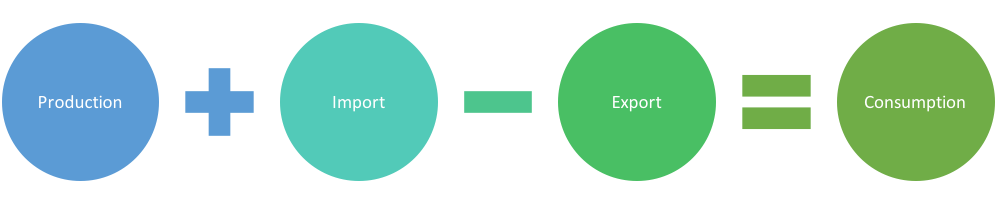
Top-down approaches (Heinonen et al., 2020) or estimations based on spending data (Broekhoff et al., 2019), utilise input-output (IO) models that are tables utilised for economic analysis, such as national accounting, and they include information on production, imports and exports for different product groups and sectors. Environmentally extended input-output models provide emissions intensities per amount spent for a particular product group. Based on the tables, emissions produced per dollar spent per consumption category can be estimated (Broekhoff et al., 2019). These models increasingly provide information at a sub-national level, and according to Heinonen et al. (2020) the accuracy of the models have increased in recent years. Often, however, an input-output table or database has information available only at a national level, in which case consumption surveys can be applied to scale down the information into local level.
The basic model for accounting for consumption-based emissions based on IO models is depicted in Figure 1.
Some of the disadvantages of this model include the complexity associated with utilising vast input-output tables. Moreover, the information often needs to be adjusted to a local level which may lead to difficulties in reconciling local level data with high-level IO tables leading to robust estimations (Balouktsi, 2020). The models estimate an average emissions intensity for a category of consumption, which may neither be sensitive to developments in an emissions intensity of an industry or service, nor is the model sensitive to consumer preferences to less carbon intensive brands over more carbon-intensive ones. In addition, the data available is often dated back even for years and may not thus represent the latest developments in emissions efficiency of an industry (Heinonen et al., 2020).
Bottom-up approaches include local consumption surveys and other sources of information such as waste audits, utility billing data and so on, combined with life-cycle analyses (LCA) to estimate emissions based on physical units of consumption. Depending on the availability of information, estimating this may be either a daunting task or a reasonable exercise: having information on the emissions intensity and level of consumption are crucial in being able to utilise this approach. Balouktsi (2020) and Broekhoff et al. (2019) both basically discard the feasibility of a full process-based LCA approach at a city scale. Sometimes national household emissions patterns are scaled down to the local level, but these estimations are rough and may omit specific local patterns of consumption.
In addition to mere top-down or bottom-up approaches, hybrid models can be utilised. Basically, hybrid models utilise data from input-output analyses to get an overall view on emissions and include more detailed life-cycle analysis data for a part of the products or services. When conducting a hybrid analysis, specific attention needs to be paid to the comparability of data. Different datasets may have differing underpinning assumptions that make comparison difficult; for example, some input-output tables may utilise destination-based accounting while consumption data may be residence-based (see more about methodological choices in chapter 3.2). However, hybrid models may be functional and increase the accuracy of results or sensitivity of data about change (Broekhoff et al., 2019) when constructed carefully, being transparent about methodological choices made.
3.2. General underpinnings of local level consumption-based emission accounting
Consumption-based emissions inventories are essentially models, rough estimations or approximations about the emissions related to consumption in a specific area. When estimating consumption-based emissions, there are several methodological choices to be made that will have an impact on the results. Heinonen et al. (2020) reveal that methodological choices may lead to a difference of up to 80 % in the estimated emissions. Thus, being explicit with the choices made is paramount.
Emissions accounting may be done from two different perspectives: residence-based accounting or destination-based accounting. Residence-based accounting allocates “to a consumer the GHG emissions caused by his/ her consumption regardless of the geographic location of the occurrence of the emissions” (Heinonen et al., 2020). Destination-based accounting, on the other hand, allocates to the studied location the emissions from final purchases on the location, including the emissions from global supply chain and production, independently of the original residence of the persons (Heinonen et al., 2020). In the latter case, local emissions may be distorted for example by a high level of tourism, or if a commuting city receives high numbers of daily commuters.
In their analysis of 111 academic articles on consumption-based emissions estimations Heinonen et al. (2020) conclude that main factors contributing to differing results for consumption-based emission inventories include the approach selected (residence- or destination-based), and scope of the study, especially related to whether governmental and private sector consumption is included. Heinonen et al. (2020) distinguish between “personal carbon footprint” and “areal carbon footprint” based on whose consumption is accounted for: the former includes only the consumption of the residents of the city, while the latter includes additionally government consumption and private investment. Including or excluding the latter may influence the results by 10-50 %, thus omitting the two other consumer groups may distort the results considerably.
In addition, methodological choices such as the number of GHGs accounted for, inclusion or exclusion of land-use change, as well as methods for accounting for direct energy use (for example heating costs may be hidden in housing bills), and ways in which emissions from durable goods are allocated to the end-user all influence the results. Finally, imports are included and accounted for very differently in many of the studies. Often, imports are given the same emissions coefficients as national production, which may be misleading (Heinonen et al. 2020).
Balouktsi (2020) brings forth also the categorisation of emissions into differing groupings in different studies. Lack of standards in reporting reduces comparability of information as well as verifiability, which would both be important for a municipality.
Further differences are caused for example by the presentation of the data: it can be presented only as total consumption-based emissions, or emissions per household, per capita or per consumption unit. Some studies differentiate between domestic, public and private sector consumption, while others present them all blended together.
Since the field is relatively new, especially at the municipal level, there is still a big variation in how the emissions inventories are conducted, which makes it difficult for a city or municipality interested in the topic to conduct the process. Few guidelines or protocols seek to respond to this need, and they are presented further down in this chapter.
3.3. Existing standards and methodologies
While quite a few standards and methodologies exist for accounting production-based emissions at municipal level, only a few of them take into account indirect emissions from consumption – or Scope 3 emissions. In this chapter, main existing standards and guidelines produced by different organisations or research institutions are presented. Each of the selected standards and guidelines have been applied in practice in municipal level consumption-based emissions analysis.
In addition, a range of academic research analysing different methods and approaches to consumption-based emissions accounting is available. It was, however, out of the scope of this study to analyse and present them here.
3.3.1. British Standards Institution - PAS 2070
British Standards Institution has developed a standard for assessing carbon emissions at a city or municipal level. The standard covers both direct and indirect GHG emissions. The aim is to provide “consistent, comparable and relevant quantification, attribution and reporting of city-scale GHG emissions” (BSI, 2013).
The consumption-based (CB) methodology covers direct and life-cycle GHG emissions for all goods and services consumed by residents of a city. The approach is residence-based, and thus does not consider emissions generated by visitor activities or services provided to visitors. The methodology utilises a top-down approach in that it recommends the utilisation of environmentally extended input-output model based on financial flow data from national or regional economic accounts, combined with environmental account data.
The data required will include household consumption, municipal and national government (for residents benefitting from government expenditure within the city boundary), and business capital expenditure on goods and services within the city boundary.
A full emissions inventory was conducted in London as a practical application of the standard, including territorial emissions and consumption-based emissions for six greenhouse gases. The first strategy reported per capita emissions of 10.05 t CO2e/ per capita while the consumption-based approach yielded up to 14.15 t CO2e/ per capita. Total consumption-based GHG emissions in London were, thus, 40 % higher than the production-based emissions (BSI, 2014).
The study presents the results for household consumption in six quite general categories, including food and drink, utility services, household, transport services, private services and other goods and services – a typical categorisation for a consumption-based emissions inventory. However, such broad categories will give quite a limited understanding about any possible change should the study be repeated in the future. The document also presents a second analysis based on COICOP categorisation often utilised in consumption-based emissions analyses, based on 12 main categories and 40 sub-categories (COICOP is the classification of the United Nations Statistics Division for individual consumption according to purpose). However, even with this categorisation, the main emissions come from “transport services” and “electricity, gas and other fuels” and “food”. More detailed information from these categories might provide useful insight for identifying “hotspot” areas for policy planning, if the information was provided.
The report disaggregates the results also by CO2 and non-CO2 gases. The division is not common in consumption-based emissions accounting but might be interesting for policy purposes, given that for example for food, most greenhouse gas emissions come from non-CO2 emissions.
3.3.2. ICLEI USA Community-based emissions standard
Local Governments for Sustainability (ICLEI) is an international network of local governments pursuing sustainability and taking action to reduce their carbon footprint. ICLEI USA is an independent regional network of the broader international ICLEI community.
In 2013, ICLEI USA produced a protocol for local governments to account for their carbon footprints; “the U.S. Community Protocol for Accounting and Reporting of Greenhouse Gas Emissions”. The protocol is based on an international emissions standard created by World Resources Institute, C40 and ICLEI “the Global Protocol for Community-Scale Emissions (GPC)” (WRI et al. 2014) but is especially directed to the US cities. The protocol includes a voluntary section for accounting consumption-based emissions. ICLEI USA also provides training for communities on how to start their consumption-based emissions inventories (ICLEI USA, 2020).
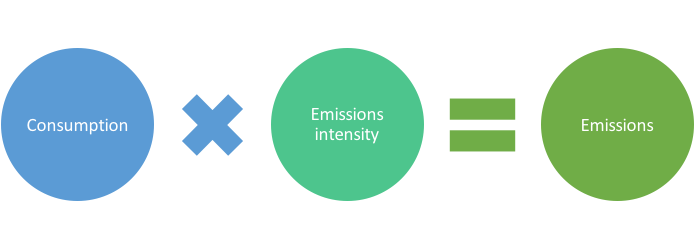
Appendix I of the protocol presents three different alternatives for conducting a consumption-based emissions inventory at a local level. Overall, the protocol takes a residence-based approach to emissions calculation, recommending to account for consumption patterns of residents of a community, independently of the place where the emissions occur. The basic principle behind emissions accounting is the following (Fig. 2):
As a first approach, the protocol recommends the possibility to utilise the CoolClimate Calculator of University of California, Berkeley (2020) that provides information of an average carbon footprint at a community level for a wide range of communities in the US. This information can be then multiplied by the number of inhabitants. The data for the calculator corresponds to the year 2008, and various data sources have been utilised to compile it. Needless to say, the approach provides a rough estimation of household consumption only and is thus recommended mainly for small municipalities with limited resources. If a community chooses to utilise this approach, the protocol recommends running the information against community’s own data sets, regarding for example emissions intensity of energy utilised, to increase accuracy (ICLEI USA, 2019).
Household surveys are another option to approach consumption-based emissions. This approach would require a municipality to either conduct a household consumption survey, or in other form have the required information at hand, such as through a national consumption survey, and then apply emissions factors to the amounts of each purchase. This is presented as a costly exercise requiring a significant level of expertise (ICLEI USA, 2019).
The third approach is to utilise a customised model utilising macroeconomic data. IMPLAN software is provided as an example – IMPLAN is essentially an input-output model covering all private industries in the US, including inter-state and international trade classified by the North American Industry Classification System (NAICS) codes (IMPLAN, 2020). While this is also a costly exercise requiring specific expertise, it allows municipalities to obtain more accurate data with detailed resolution for types of consumption. The approach includes consumption of the governmental entities and business capital investment, providing, thus, a “full” consumption-based emissions inventory (ICLEI USA, 2019).
3.3.3. Stockholm Environment Institute guidelines
Stockholm Environment Institute (SEI) has engaged in various consumption-based emissions inventory processes, and it has published guidelines or recommendations for cities or municipalities that are interested in conducting such processes. The recommendations, presented in Broekhoff et al. (2019), endorse the use of input-output tables either by spending or by physical unit data, and utilisation of consumer spending data, if available, to scale national-level information down to a local level to create a reasonably accurate emissions inventory. National level consumption data can be downscaled to a local level, but this will affect accuracy of the report.
The report also analyses the use of life-cycle analysis tables, deeming the exercise as complicated, unless relevant data is readily available (Broekhoff et al.,2019).
Moreover, the document briefly introduces simpler but less accurate ways to estimate consumption-based emission footprints. These include analysis of waste data, which is often responsive to behaviour change in consumption but leaves out many sectors of consumption – including services and transport. Broekhoff et al. (2019) also mention the possibility to base the analysis on data available from CoolClimate data or similar calculation tools – if available for the region in question. In simplest form, a city can also use existing national household consumption emissions studies and expect the same patterns of consumption to hold roughly at a city level (Broekhoff et al., 2019).
Overall, Broekhoff et al. (2019) put an emphasis on the purpose and intended use of the inventory as factors that should guide the selection of the methodology and methodological choices made. Different data sources can be utilised depending on whether the main aim is to engage in policy follow up, citizen engagement or overall data comparison between municipalities. For example, while hybrid approaches utilising a series of local level data may gain in accuracy, they will lose in comparability with other cities.
The recommendations are given at a general level. Thus, no specifications on such details as which greenhouse gases to include, or the scope of the inventory, are defined. No stance is either provided on the selection of a general approach – residence or area-based, or whether to include governmental consumption and private investment into local consumption-based emission inventories.
3.4. Possible data sources for a municipal consumption-based emissions inventory
Availability of data influences and directs the possible methodology to be utilised, alongside other considerations, such as the final use of the information.
The use of input-output tables is recommended by most of the standards and guidelines while input-output tables by spending unit (as opposite to physical unit) are most widely used for the emissions inventories (for example Heinonen et al. 2020). Each of the tables or databases have a slightly different methodological approach. For instance, their geographical focus might vary, or the scope and data resolution may be different. Some of the databases require a licence, and the prices may vary.
As a rule of thumb, one could argue that international multi-region input-output tables are especially suitable when international comparability of results will be important, while single-region tables, such as the Finnish ENVIMAT (Table 1), may provide more accurate results within the region it is designed for.
Model | What does it cover? | Cost |
ENVIMAT | An environmentally extended input-output table for Finland, developed by Thule Institute and Finnish Environment Institute. It includes 148 sectors and 229 products. It has recently been updated to cover consumption intensities for the year 2015. | n/a |
Ecoinvent | An international LCA database that can be utilised to estimate life-cycle emissions of over 10,000 products. The database is one of the main sources for estimations of carbon intensity of imports in the ENVIMAT model. | The license cost is EUR 3,800. |
Eora | A multi-regional environmentally extended input-output table including over 15,900 products in 190 countries. Includes time series from 1990 to 2015. Widely used by academia, international organisations and global companies. | Licence required |
Exiobase | A multi-regional environmentally extended input-output table currently covering 43 countries, 200 products and 163 industries. The latest version covers data for the year 2011. Frequently utilised in academic research. | Free |
Global Trade Analysis Project, GTAP GMRIO | A global multi-regional environmentally extended input-output database and a tool to analyse global trade relations, including information on emissions. Has data for 121 countries and 65 sectors, covering years 2004, 2007, 2011 and 2014. Good international comparability. Utilised by C40 et al. (2018) study. | A single licence fee is USD 6,240 for non-academic sectors. |
IMPLAN | Economic modelling tool for the US, includes input-output tables for over 550 sectors, divided by intra-state, inter-state and international trade. Possible to add environmental data, including various GHGs. Updated continuously. Regularly utilised for consumption-based emissions inventories. | Pricing structure varies from USD 1,500 to 6,000 for a single state. |
US EIO-LCA Carnegie Mellow University | Economic input-output life cycle assessment tool. It has data for the US and a few other countries are included, e.g. Germany and Peru. The information dates back to 2002. It has regularly been utilised for academic studies in the past. | Free for non-commercial use, deeper investigation of data may require a licence. |
WIOD | WIOD is an input-output database covering 43 countries, and data for 56 sectors. It covers time period from 2000 to 2014. | Undefined |
None of these input-output tables provide information scaled down to a municipal level. Hence, information about consumption at a local level needs to be obtained from other sources, to be then combined with the relevant input-output data. Basically, both academic and non-academic studies on consumption-based emissions in Finland have so far relied on data from Statistics Finland's consumption surveys that are repeated and released every four years. For example, Finnish Environment Institute (SYKE) utilises consumption data from 2016 in the most recent survey of consumption-based emissions in Finland (Nissinen and Savolainen, 2019). In the absence of consumption data, municipalities have conducted their own consumption surveys, as it will be discussed further along in this report.
While input-output tables and consumption data are the main components of a consumption-based emissions study based on top-down approach, other municipal level data will be required. For example, C40 et al. (2018) illustrate data sources utilised for their study, which include additional data on private transport and household energy emissions data, as well as data on city industrial output to scale down national emissions factors for industrial production.
Both Broekhoff et al. (2019) and Balouktsi (2020) raise a concern that a municipality might easily focus too much time and resources on conducting a high-accuracy consumption-based emissions inventory instead of maintaining the focus on actual implementation of activities that focus on reducing emissions from consumption. Thus, they suggest that finding more simple solutions to measure such emissions can be a viable option. These may include studying waste data or different carbon footprint databases.
In the case of Finland, supermarket chains have developed their own carbon footprint calculators available for the members of their loyalty programmes. Members of Kesko’s loyalty programme can now follow up the carbon footprint of the items purchased at a product group level. The footprint calculator is based on Natural Resources Institute Finland’s (LUKE) LCA analyses for different product categories (Kesko, 2019). Similarly, another big Finnish grocery store chain, S-ryhmä, published its own calculator for the members of their loyalty programme, similarly utilising the LCA data from LUKE (S-ryhmä, 2019). Based on the statistics of Finnish Grocery Trade Association (PTY 2019), the combined market share of these two supermarket chains was 83 % in 2019 in Finland. If it was possible to combine the consumption data of these two actors on a local level, estimations of consumption and emissions might be possible to draw at least for certain consumption categories.
Another approach worth assessing would be to analyse the data from a specific carbon footprint calculator directed to consumers to determine typical consumption patterns, and to extend the results to the whole population of the city. Some considerations would be necessary; for instance, the persons that tend to respond to such calculators, tend to already be environmentally more conscious than an average consumer, and the results would need to be adjusted to be more representative of the population of the area.
Examples of consumption-based emissions inventories
In this chapter, three different examples of sub-national or municipal level consumption-based emission inventories are presented. The cases were selected from examples of publicly available inventories conducted or commissioned by municipal or regional authorities to estimate consumption-based emissions within their jurisdiction. Thus, academic studies were excluded at this point. The cases were searched through references in relevant literature, both academic and non-academic, as well as through information disclosed publicly by relevant networks and organisations such as ICLEI or C40. There is a bias in the search towards the northern hemisphere's and European cities, as well as towards information produced in English language.
The total of eleven examples found, summarised in Annex, demonstrate that such inventories are not yet common at city or municipal level, even if the search was not systemic enough to estimate the frequency at which such studies have been conducted. However, existing studies are enough to reveal useful insights into processes related to estimating consumption-based emissions at a local level. It should be noted that a higher number of cities might engage in activities related to reducing consumption-based emissions for example through increasingly common circular economy activities, but the interest here is especially in full emissions inventories conducted.
The cases selected for further analysis in this chapter include the region of King County in the US, as well as Philipstown in the New York State in the US and the Umeå Municipality in Sweden. The case examples were selected so that they represent different approaches to the topic, and more recent analyses were preferred to older ones. Thus, some comprehensive or methodologically sound analyses were left out, even if information from them is being utilised in the discussion section.
The main interests for this study were whether a city or region had included consumption-based emissions in their climate strategy or target setting, the methodology utilised to conduct the emission inventory, and any projects or concrete action taken on the basis of the information.
In addition to municipal and regional level cases from outside Finland presented in this chapter, previous studies related to consumption-based emissions in Finland are briefly discussed in this chapter. These include both academic and non-academic studies.
4.1. King County, Washington, USA
King County is a county in the State of Washington, West Coast of the United States. The capital city of the region is Seattle, and the total estimated population reaches 2,3 million inhabitants (U.S. Census Bureau, 2019). The per capita income was US$ 49,300 which is 50 % higher than the average national income.
King County is one of the few sub-state or sub-national entities that have completed a consumption-based emissions inventory in their jurisdiction more than once. Indeed, it can be said to be somewhat of a pioneer in the topic since the first consumption-based emissions inventory was published already in 2008 – at a time when such inventories hardly existed.
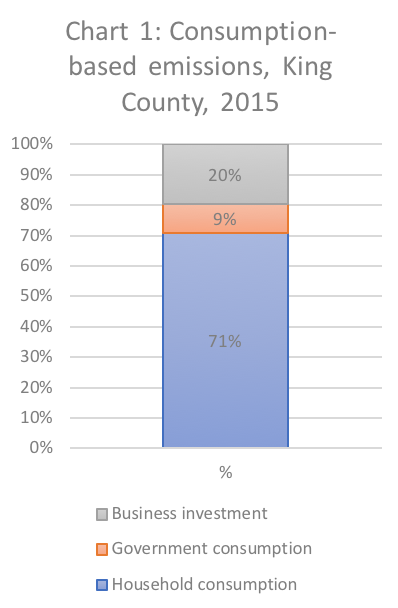
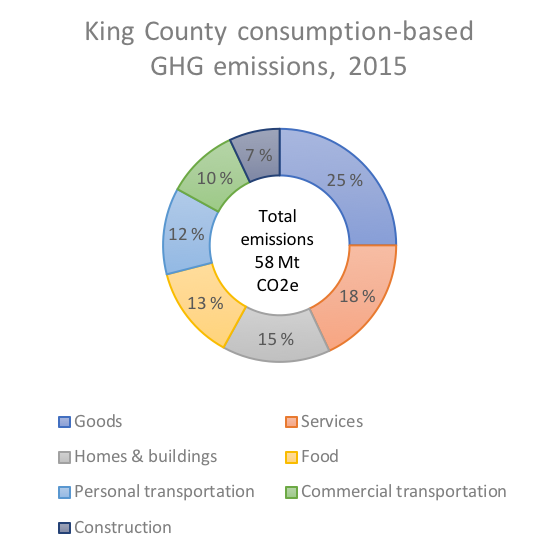
A new consumption-based emissions inventory was published in 2017, containing data from 2015. According to the inventory, the consumption-based emissions in the King County area totalled 58,165 MtCO2e during 2015. Out of that, household consumption comprised 71 %, governmental consumption 9 % and private investment 20 % (Fig. 3). Consumption categories with the highest emissions were goods, services, homes and buildings followed by food and personal transportation (Fig. 4) (Cascadia and Hammerschlag, 2017).
The results from 2015 demonstrate a 5,8 % increase in total consumption-based emissions from 2008, when the previous study was conducted. The per capita spending decreased by 7,8 % during the period, but the report does not mention whether the reduction in spending turned into decreased per capita emissions. Indeed, the report does not present emissions in per capita terms but only in total absolute terms (Cascadia and Hammerschlag, 2017).
The authors of the report utilised the IMPLAN model to obtain data on community demand, as well as imports and exports of 536 categories of commodities. Data for product use and disposal were available through a simultaneously prepared territorial emissions inventory, including information on electricity consumption, vehicle use, heat and hot water, garden and recreation equipment, and landfilling (Cascadia and Hammerschlag, 2017).
One of the shortcomings of the 2015 study is that the emissions intensities related to each sector were not updated in 2015 from the figures utilised in 2008. Thus, any change towards adopting more low-emitting technologies in an industry would not have been be reflected in the results (Cascadia and Hammerschlag, 2017). Overall, obtaining comparative data for two consecutive data sets seem to have proven challenging with the data sources utilised for this study.
Currently, King County is in the process of finalising a new strategic climate action plan that covers emissions mitigation, adaptation and climate preparedness in the region. The draft plan mentions consumption-based emissions, and the means to tackle these include education of citizens, promotion of circular economy, improving recycling and reducing waste, as well as reducing emissions from county procurement strategies. No numeric target for reducing consumption-based emissions have been set, however, the new Strategic Climate Action Plan commits to renewing the consumption-based emissions inventory by 2021. The county has an overall goal to reduce emissions at least 50 % by 2030 and 80 % by 2050, as well as reducing emissions from the County’s government operations by 80 % by 2030 (King County Climate Action Team, 2020).
4.2. Philipstown, New York, USA
Philipstown is a small town with 9,700 habitants in the East Cost of the United States. It is a part of the New York State, as well as Putnam County. The average number of households is 3706 with per capita income of US$ 56,400 in 2018, which is over 50 % higher than the average income in the country (U.S. Census Bureau, 2019).
In 2017, Philipstown joined a state-level initiative, “Climate Smart Communities” program, which includes the creation of a local climate action plan. As part of the initiative, Philipstown conducted a complete community-based GHG inventory including consumption-based emissions that was published in 2020 (Angell and Apicello, 2020). This is a first community level GHG inventory in the New York State that includes both territorial and consumption-based emissions counting. In addition, the inventory document includes a land-use inventory. Philipstown is a member of ICLEI USA, which has significantly supported the inventory together with a local environmental NGO Ecological Citizens Project.
According to the inventory report, the territorial emissions were 11.1 tCO2e/ per capita in 2016, of which 61 % came from transport and 20 % from residential energy. The consumption-based emissions reached 20.4 tCO2e/ per capita in 2019, and services, food, household heating, and travel with private vehicles contributed to most to the emissions (Fig. 5).
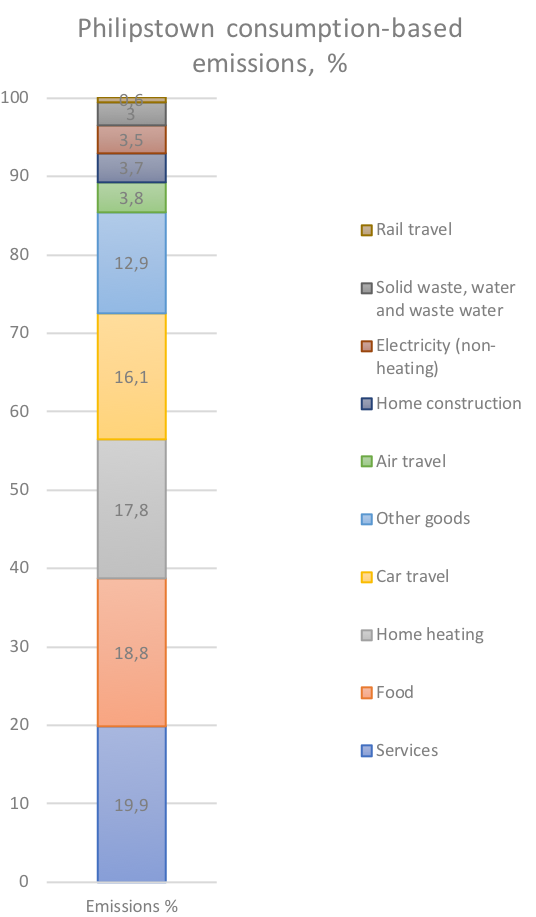
The inventory was conducted based on ICLEI USA’s US community protocol (see ICLEI USA, 2019 for the protocol). ICLEI’s ClearPath calculator was utilised to estimate the territorial emissions. To estimate consumption-based emissions, a separate household consumption survey with 261 valid responses was conducted. In addition, consumption of services – including governmental services such as health and education was estimated utilising median income as a proxy for household consumption of services. Part of the food consumption as well as other information were complemented with data from national statistics. The category of other goods and services was estimated based on the data obtained from CoolClimate calculator (Angell and Apicello, 2020). Thus, the final methodology is a hybrid approach including LCA analysis for the main consumption items complemented with data from other sources.
All in all, the Philipstown community-based emissions inventory is an enthusiastic attempt to obtain reasonably accurate emissions data even when availability of data at the local level is limited. While the limitations of the data are openly discussed, such as skewness of data towards higher income and more well-educated respondents, the results are reasonably in line with other similar studies (see Angell and Apicello, 2020). Indeed, the information could be utilised for future policy purposes even if the inventory report is too recent to evaluate its impact on the local policy making and climate target setting.
4.3. Umeå Municipality, North-East Coast, Sweden
Umeå is a city on the northern coast of Sweden, with 129,000 inhabitants in 2020. It belongs to the region of Västerbotten. It has a relatively young and growing population, likely related to the presence of a local university (Umeå kommun, 2020a).
Umeå has set ambitious climate goals, and in 2018 it conducted a consumption-based emissions inventory to better understand emissions from consumption in the city and to guide future policy making.
The city’s new environmental goals published in early 2020 include climate targets for both territorial and consumption-based emissions. The city has the goal to be carbon neutral by 2040, meaning an 85 % of reduction of territorial emissions compared to the year 1990. The aim is to reduce consumption-based emissions from the current 11,5 tCO2e/ per capita to 2 tCO2e/ per capita in 2040 and to 1 tCO2e/ per capita in 2050 (Umeå kommun, 2020b).
The consumption-based emissions inventory indicated that the consumption-based footprint per capita in Umeå in 2018 was 11,5 tCO2e/ per capita including government consumption and private capital formation (Fig. 6) (Axelsson et al., 2018). This is higher than the average of 9 tCO2e/ per capita consumption-based emissions for Sweden in general. However, the results are not entirely comparable since different methodologies were utilised to calculate the footprints for Umeå and for the whole country.
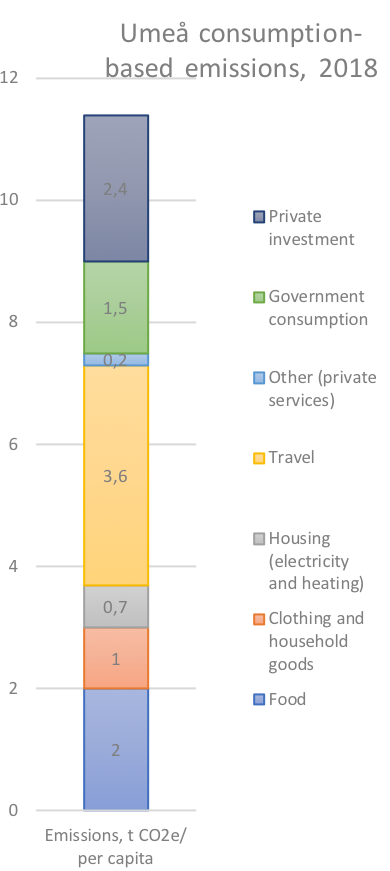
According to the inventory, most of the consumption-based emissions come from travel, which averages up to 3.6 tCO2e per inhabitant (Fig. 6). Out of this, air travel comprises two-thirds, and the rest comes mostly from private car travel. While the emissions from the private car use seem to be in line with the Swedish average, the emissions of air travel of the residents of Umeå are significantly higher than the national average.
Other important emission categories include emissions from food together with government consumption and private investment.
Umeå Municipality utilised a mixed methodology to conduct the consumption-based emissions inventory. First, a local household consumption survey was conducted with an external consulting company with a total of 1475 approved responses. The results from the consumption survey were turned into emissions inventory in a joint project with SEI. SEI utilised both input-output tables and LCA analysis to estimate the emissions: especially items in the food category were estimated through an LCA analysis, whereas input-output tables were utilised for most of the rest of the items. While the consumption survey was conducted in 2018, it was not possible to obtain equally recent data for emissions factors for the consumption categories, and most recent data available has been utilised, that being mostly for 2016, but varying between 2015 and 2017 (Axelsson et al., 2018).
In the consumption survey, older and more educated respondents were overrepresented compared to the distribution of the population in the city. Thus, SEI presented both the actual results, and results weighted by the population to increase accuracy. Umeå Municipality is now using the weighted results in their official communication and statistics. In addition, the consumer survey did not include all consumption categories that are part of traditional consumptions classifications (such as COICOP), and thus for calculating the carbon footprint, categories were added representing the Swedish average. Finally, data about government consumption and private investments were estimated and added separately (Axelsson et al. 2018).
SEI created a model according to which Umeå Municipality can estimate consumption-based emissions also in the future with updated information (Axelsson et al. 2018). SEI also identified hotspots, which could be the first points of attention to start reducing consumption-based emissions. These include flying and car travel, meat consumption, food waste, household energy and consumption of clothing and durable goods. For example, only 18 % of the respondents to the consumption survey affirmed they utilise climate neutral electricity.
Umeå Municipality has integrated consumption-related approach into its climate work. A project “climate neutral place” (Klimatneutrala platsen) as part of a wider “Climate Neutral Umeå 2030” programme integrates activities in various spheres and seeks to promote sustainable life choices amongst the inhabitants in Umeå. The second phase is ongoing from 2020 to 2022. Past activities have included promotion of cycling within the city, initiatives to make restaurants more sustainable, promoting housing co-operatives to support more sustainable life-styles, engaging with schools for sustainable life choices, and integrating the consumption-based perspective into monitoring climate emissions (Umeå kommun, 2019). Citizen engagement is clearly at the heart of the climate work, and Umeå municipality also created a webpage to represent the most central findings of the consumption-based emissions report (Umeå kommun, N.d.).
Overall, Umeå is an example of some of the few cities that have fully integrated consumption-based approach in their climate strategy, including target setting for consumption-based emissions, emissions inventory and follow up, as well as having in place strategies and activities that target emissions reduction from the consumption perspective.
4.4. Consumption-based emissions in Finland
The topic of consumption-based emissions or household carbon footprints has been studied to some extent in Finland, especially in research institutions and academia. While no inventories induced by Finnish municipalities were found, some of the existing research is presented here.
The Finnish Environment Institute (SYKE) has conducted consumption-based emissions calculations for Finnish households in 2002, 2005, 2015 and 2019 utilising ENVIMAT model, that is environmentally extended input-output table specifically constructed for Finland (see Table 1). According to the latest report, the average consumption-based emissions in Finland totalled 73.4 MtCO2e in 2015 (Nissinen and Savolainen, 2019), while the territorial emissions for the same year were 55 MtCO2e (Tilastokeskus, 2019). Thus, the consumption-based emissions were approximately 33 per cent higher compared to the territorial ones. In terms of per capita figures, consumption-based carbon footprint in Finland was 13,400 kgCO2e/ per capita in 2015 (Nissinen and Savolainen, 2019). While Finnish territorial emissions have decreased between 2000-2016, the consumption-based emissions have remained more or less the same, indicating that increase in consumption outweigh the gains in emissions savings elsewhere (ibid., 2019).
Other recently published studies on consumption-based emissions in Finland include the report “1.5 degree lifestyles” associated with Sitra’s (The Finnish Innovation Fund) work on sustainable lifestyles. According to this report by IGES et al. (2019), the current consumption-based carbon footprint of Finnish households reaches approximately 10,400 kgCO2e/ per capita, of which a reduction down to 700-1,000 kgCO2e/ per capita by 2050 would be required to maintain the consumption-based emissions in line with the targets to maintain the global temperature within the limit of 1.5 degrees (IGES et al. 2019).
Ottelin et al. (2018b) compare consumption-based carbon footprints and material footprints of different income groups in Finland. The per capita footprint, including government services and consumption, totalled 12,310 kgCO2e in Finland based on 2012 consumption data. Their main findings include the notion that income transfers related to public welfare services balance to some extent carbon footprints of households in different income groups. Even so, the household carbon footprint tends to correlate highly with available income.
Research conducted on consumption-based emissions at a local level, including the Helsinki metropolitan area, dates back 10-15 years. A comparative research study between cities reveals that consumption-based emissions based on data from 2006 were 11,100 kgCO2e/ per capita in Vantaa, 12,400 kgCO2e/ per capita in Helsinki and 14,400 kgCO2e/ per capita in Espoo (Heinonen and Junnila, 2011a). The study compares carbon-based footprints in the Helsinki metropolitan area and the Tampere metropolitan region, concluding that income is heavily correlated with the carbon footprint of city residents, as opposed to for example population density. The highest share of the carbon footprint comes from electricity and heating, followed by other housing related emissions and private transport. Another comparative study between the consumption-based emissions in Helsinki and Porvoo revealed interesting differences: while the overall footprint of Porvoo was lower than that of Helsinki, mainly due to lower emission intensity of district heating, the emissions from private transport were significantly lower in Helsinki (Heinonen and Junnila, 2011b). Understanding the city-specific carbon footprint may help to tailor effective city-specific policies to tackle consumption-based emissions.
Some studies analyse footprints of different consumer groups, such as “high-rise” and “low-rise” living (Ala-Mantila et al., 2013), or urban zones (Ottelin et al., 2018a) within the Helsinki metropolitan area. These studies indicate that residents living in detached housing in outskirts of Helsinki metropolitan area tend to have a higher carbon footprint than those that live in the urban zones with good public transport connections. On the other hand, the highest carbon footprints are found in the city centre (of Helsinki), correlated with the highest available income.
Discussion
Following up GHG emissions from the consumption perspective can be beneficial in many ways: consumption-based emission inventories may reveal new emission hotspots that can be influenced through municipal policies. They may also show new information about the effectiveness of local and national policies on emissions reduction. Often comprising significantly higher emissions than territorial emissions, they should not be ignored.
Balouktsi (2020) brings up further benefits related to the consumption-based emissions analysis and municipal planning: planning for consumption-based initiatives essentially encourages participation of residents to the emissions reduction process. While municipalities might not be able to directly influence most of the consumption-based emissions in their areas, there are indirect ways in which they can engage and motivate residents to act to diminish their carbon footprint. Consumption-based emissions inventories offer an opportunity to highlight the impact of actions of individuals and households and provide insight into lifestyle choices, potentially helping residents engage in climate action. The approach also encourages fairer global burden sharing by making the impact of consumption in the Global North more visible. Despite the alleged benefits, not many cities have opted to integrate consumption-based approach in their climate work.
5.1. Purpose of the inventory and methodology to be chosen
As indicated earlier in this report, the intended use of information should determine the kind of emissions inventory to be conducted. Broekhoff et al. (2019) highlights that the purpose of the study should guide selection of the methodology; inventories for policy follow up, citizen engagement or overall data comparison between municipalities may require different approaches.
In terms of policy follow up, establishing concrete emissions reduction targets is a key to understanding and achieving change. So far, integrating consumption-based emissions targets into municipal or regional level climate strategies or action plans does not seem to be common. Indeed, only two of the cities studied, Umeå and Gothenburg, have included clear numeric targets for reducing consumption-based emissions as a part of their climate or environmental policies. Other few cities, amongst which are at least Manchester, San Francisco, Seattle, and Stockholm, mention the need to tackle consumption-based emissions but do not show explicit numeric targets set for their reduction. Thus, in many occasions, consumption-based emissions analyses seem to act as complementary information to municipal planning rather than an integral part of greenhouse gas emissions reduction strategies.
Some consumption-based inventories presented in this study were better suited for citizen engagement than others. The inventories in King County remained at a general level, presenting emissions only in absolute terms, and having a strict focus on changes in overall spending on goods and services without providing any suggestions on how emissions produced by the spending could be tackled. An opposite approach is adopted in the Philipstown’s emissions inventory, that has been directed to the inhabitants of the area, opening up difficult concepts and contributing to the understanding what a consumer or a resident can do to contribute to low carbon development. The report commissioned by Umeå Municipality includes recommendations on specific hotspot areas for emissions reductions suitable for citizens, and the city has engaged actively on communication about consumption-based emissions with the citizens.
Conducting a consumption-based emissions inventory requires a series of methodological choices, which will affect the results. The lack of standardised approaches to collecting consumption-based emissions data and presenting it reduces comparability of information between cities. While comparability might not be the main aim of a local inventory, being able to benchmark with other cities might provide interesting insight into the local emissions. The inventories analysed for this report had all very different scopes, and the results were represented so differently that comparison between them was not possible. For example, some of the models incorporated government consumption and business investment into a single footprint with household consumption whereas other studies maintained these three spheres separate and some studies only estimated emissions for household consumption. The results were presented in absolute sums, per household or per capita – but rarely so that comparison would be possible. Indeed, comparison of results was not possible even at a high level. Separate studies exist, though, for comparative purposes, such as the C40 comparative report on the consumption-based emissions in 79 cities (C40 et al., 2018). However, from the perspective of city planning it might be more important to be able to conduct regular follow up studies with consistent methodology than focusing too much on comparability if resources are limited.
5.2. Data availability
In addition to the methodological choices, both access to data and data availability influence the type of emissions inventory possible to conduct. Input-output databases, which are most frequently utilised in the consumption-based emissions analyses, tend to require licence fees, even if cost-free databases exist. In addition, they rarely provide information at a sub-national level, thus local level consumption data is required to scale down the information. Sometimes this can be derived from national consumption surveys, but in other occasions such survey needs to be conducted. Two of the three examples presented in this report conducted a local consumption survey as a part of the consumption-based emissions inventory. In addition, local level data on many topics, such as transport or energy use will be always required.
Overall, most reports and protocols suggest contracting an external consulting company to conduct the consumption-based emissions inventory given the complexity of the task. On the other hand, Balouktsi (2020) reminds that from the perspective of municipal policy, it would be more important to have “reliable enough” data that support actual policy-making rather than spending the available resources into producing a study with a high-class local accuracy. It might be reasonable to create a rough estimation of key sources of information and then to follow up more closely those areas through specific indicators (Balouktsi, 2020). Examples from less resource intensive studies include the Philipstown report (Angell & Apicello, 2020), where a (small) municipality had been able to conduct a reasonably reliable study. The greenhouse gas emission survey of Paris is also interesting in this view; while the city mostly follows territorial approach, selected indirect or Scope 3 emissions are included in the analysis, including food consumption, upstream energy and air travel (City of Paris, 2018).
Replicating an inventory requires almost the same level of effort than conducting the first one, and so far, it seems that not many cities follow consumption-based emissions at frequent intervals. Out of the twelve cities studied, consumption-based emissions surveys were utilised for frequent monitoring of cities’ carbon footprint only in few cases. At least London, Portland and King County had reproduced or updated the inventory, and Paris is following its extended territorial emissions in five-year intervals. Gothenburg explicitly stated it aims to repeat the previous study in the near future.
A factor that influences the possible update of a consumption-based emissions inventory is the rate at which updated data sources are available. Indeed, the frequency and timing of updating the information should concord with availability of updated data. In the case of King County, the authors were unable to update emissions intensities from the previous study, which basically left out the contribution of potential technological change to the level of emissions, leaving only the impact of changing levels of consumption visible and decreasing the accuracy of the results. Sometimes data from consumption is hard to obtain frequently: for example, in Finland, Statistics Finland conducted the most recent household consumption survey in 2016 and the next one is foreseen to be published in 2022. Equally, many input-output tables are updated at four to five years intervals if updated at all, and even then, the data tends to date back several years. Thus, the availability of updated information affects the possibility for continuous monitoring of consumption-based emissions, and the results will hardly ever represent the most recent changes in technology.
5.3. Influencing consumption-based emissions
Consumption-based emissions may “behave” differently from territorial emissions, and understanding some of the key considerations helps plan for effective policies and follow up strategies. Follow up reports of consumption-based emissions indicate that while reductions have been made in territorial emissions compared to the baseline years in most cities, the level of consumption-based emissions has remained almost the same. This holds true equally for example in Finland, Sweden, London as well as many of the cities in the US. Indeed, a number of longitudinal emissions inventories demonstrate that the household carbon footprint is difficult to change. For example, Nissinen and Savolainen (2019) argue that the consumption-based carbon footprint in Finland has hardly changed between 2000 and 2016 even if the Finnish territorial emissions decreased during the same period by 16 %. Increased consumption offsets any technological change that contributed to reducing emissions.
Change in the consumption-based emissions occurs through three different mechanisms: reduced consumption, change in the type of consumption, and technological change. For example, Nissinen and Savolainen (2019) demonstrate that of the total increase in the consumption-based emissions between 2000 and 2016 in Finland, increased overall consumption contributed to 31 % increase in the emissions, while change in the type of consumption contributed to a mild decrease in the emissions (-5,7 %). Technological change further reduced the emissions by 12 %. All in all, the impact of increased consumption surpassed the reduction achieved through the two other forms.
Academic research indicates that emissions reduction or change of consumption behaviour in one area is often outweighed by increased or more carbon-intensive consumption in another area. This is frequently called as the “rebound effect”. Indeed, Junnila et al. (2018) demonstrate how circular economy, reduced ownership and a tendency towards shared products had hardly any impact on consumption-based emissions of mid-income households in Finland. Equally, middle income car-free households tend to allocate money to holiday travel offsetting the emission savings from not having a car by more carbon intensive air travel. Eventually, families or households characterised with “light drivers” – who have a car, but do not drive much – tend to have the lowest carbon footprints (Ottelin et al., 2020).
The report of the Finnish Climate Change Panel also brings forward possible macro-scale rebound effect: when a numerous groups of persons chooses not to consume a certain product or service, it may result in lowering product prices, which then increases the consumption of the product by others (Linnanen et al., 2020).
Thus, tackling consumption-based emissions requires a full understanding of the mechanisms how different policies and incentives to reduce emissions from consumption may influence consumer behaviour. The follow up of local consumption-based emissions should be thorough enough to find out how changes in the type of consumption evolve over time and to reveal possible rebound effects.
Conclusions
The idea of measuring consumption-based emissions at a sub-national level is relatively new and not yet widely spread in practice. Only a few cities or municipalities have made attempts to estimate such emissions in their jurisdiction and even fewer have set explicit targets in their climate strategies or climate action plans to reduce consumption-based emissions in their areas.
Consumption-based approaches may give important insights into emissions within a city compared to more traditional territorial approaches. They may also serve to identify emission hotspots as well as reveal new information about the effectiveness of different emissions reduction strategies. These two approaches can be seen complementary rather than alternatives to each other.
A few protocols and guidelines exist for conducting a consumption-based emissions inventory. Such initiatives include British Standards Institution’s PAS2070, US community-based emissions standard and SEI’s guidelines for consumption-based emissions inventories. While these provide a wider methodological framework and guidance for setting the scope of the inventory, they can be loosely interpreted and actual consumption-based inventories differ vastly one from another.
Consumption-based emissions inventories are essentially estimations, but methods to conduct such inventories have improved in recent years. The most common approach is to utilise environmentally extended multi-regional input-output tables to estimate flows of goods and services and related emissions in an area, downscaled to local level for example through information from consumption surveys. Other options include utilisation of LCA information for different product groups or more “light” analyses such as follow up of different local carbon footprint calculators.
The purpose or the main use of the information should guide the methodology selected for conducting a consumption-based emissions inventory. Equally, availability of data and possibility to update the inventory should also be considered.
Due to different rebound effects, decreasing consumption-based carbon footprint may result difficult. The footprint tends to increase with higher available income. Both consumer behaviour and technological change play an important role in achieving change. To design effective policies, it is important to understand to what kind of incentives different resident groups may react.
References
Ala-Mantila, S., Heinonen, J. and Junnila, S. (2013), Greenhouse gas implications of urban sprawl in the Helsinki Metropolitan Area, Sustainability, vol 5: 4461-4478, accessed 23.09.2020
Angell, J. and Apicello, J. (2020), , accessed 09.09.2020
Axelsson, K., Vanhuyse, F. and Dawkins, E. (2018), , SEI report December 2018, accessed 30.09.2020
Balouktsi, M. (2020), Carbon metrics for cities: production and consumption implications for policies, Buildings and Cities, 1(1): 233-259, accessed 15.09.2020
Broekhoff, D., Erickson, P. and Piggot, G. (2019), Estimating consumption-based emissions at the city scale – a guide for local governments, SEI report January 2019, accessed 07.09.2020
BSI (British Standards Institution) (2014),Application of PAS 2070 – London, United Kingdom – An assessment of greenhouse gas emissions of a city, accessed 01.09.2020
BSI (2013), Specification for the assessment of greenhouse gas emissions of a city – Direct plus supply chain and consumption-based methodologies, PAS 2070:2013 incorporating amendment nro 1, accessed 01.09.2020
Cascadia and Hammerschlag (2017), King County Greenhouse Gas Emissions Inventory, A 2015 Update, accessed 20.09.2020
C40, University of New South Wales, University of Leeds and Arup (2018), Consumption-based GHG emissions of C40 cities, accessed 03.09.2020
City of Paris (2018), Paris Climate Action Plan, accessed 5.10.2020
Heinonen, J., Ottelin, J., Ala-Mantila, S., Wiedmann, T., Clarke, J. and Junnila, S. (2020), Spatial consumption-based footprint assessments: a review of developments in the field, Journal of Cleaner Production 256, 20 May 2020, 120335, accessed 07.09.2020
Heinonen, J. and Junnila. S. (2011a), Implications of urban structure on carbon consumption in metropolitan areas, Environmental Research Letters, vol 6:1, accessed 24.09.2020
Heinonen, J. and Junnila, S. (2011b), Case study on the carbon consumption of two metropolitan cities, International Journal of Life Cycle Assessment, vol 16: 569-579, accessed 23.09.2020
Heinonen, J., Jalas, M., Juntunen, J.K., Ala-Mantila, S., Junnila, S. (2013), Situated lifestyles: How lifestyles change along with the level of urbanisation and what the greenhouse gas implications are – a study of Finland, Environmental Research Letters, vol 8:2, accessed 23.09.2020
HSY (Helsingin seudun ympäristöpalvelut) (2020), Kestävän kaupunkielämän ohjelma, Luonnos 11.12.2020 [Sustainable urban living programme, Draft 11.12.2020, Helsinki Region Environmental Services, in Finnish], accessed 15.2.2021
ICLEI USA (2019), U.S. Community Protocol for Accounting and Reporting of Greenhouse Gas Emissions - Version 1.2, downloaded 7.9.2020
IGES (Institute for Global Environmental Strategies), Aalto University, and D-mat ltd. (2019), 1.5-Degree Lifestyles: Targets and Options for Reducing Lifestyle Carbon Footprints. Technical Report, Hayama, Japan, downloaded 7.9.2020
Junnila, S., Ottelin, J. and Leinikka, L. (2018), Influence of reduced ownership on the environmental benefits of circular economy, Sustainability, vol. 10, 4077, accessed 29.09.2020
King County Climate Action Team (eds.) (2020), King County Strategic Climate Action Plan, King County, Washington, accessed 10.09.2020
Kesko (2019), K-ostokset-palvelu paljastaa nyt ruokaostosten hiilijalanjäljen[K-purchases service now reveals the carbon footprint of food shopping, available in Finnish], accessed 29.09.2020
Linnanen, L., Nyfors, T., Heinonen, T., Liimatainen, H., Nissinen, A., Regina, K., Saarinen, M., Seppälä, J. and Viri, R. (2020), The sufficiency perspective in climate policy: how to recompose consumption, Suomen ilmastopaneeli /The Finnish Climate Change Panel, Raportti 4/2020, accessed 29.09.2020
Nissinen, A. and Savolainen, H. (eds.) (2019), Julkisten hankintojen ja kotitalouksien kulutuksen hiilijalanjälki ja luonnonvarojen käyttö – ENVIMAT mallinnuksen tuloksia, Suomen ympäristökeskuksen raportteja 15/2019, accessed 07.09.2020
Nissinen, A., Rantsi, J., Lounasheimo, J., Huuska, J. and Niemi, J. (2012), Kuntien hiilijalanjälkilaskuri KUHILAS – Kasvihuonekaasupäästöjen seurantaa kuntatasolla tarvitaan, Ilmansuojelu, 3/2012: 26-29, accessed 15.02.2021
Ottelin, J., Heinonen, J. and Junnila, S. (2020), Rebound effects for reduced car ownership and driving, in Kristjánsdóttir, S. (ed.), Nordic experiences of sustainable planning: Policy and Practice, Routledge
Ottelin, J., Heinonen, J. and Junnila, S. (2018a), Carbon footprint trends of metropolitan residents in Finland: How strong mitigation policies affect different urban zones, Journal of Cleaner Production, 170:1523-1535, accessed 15.09.2020
Ottelin, J., Heinonen, J. and Junnila, S. (2018b), Carbon and material footprints of a welfare state: Why and how governments should enhance green investments, Environmental Science and Policy, 86:1-10, accessed 15.09.2020
Ottelin, J., Ala-Mantila, S., Heinonen, J., Wiedmann, T., Clarke, J. and Junnila, S., (2019), What can we learn about consumption-based carbon footprints at different spatial scales? Review of policy implications, Environmental Research Letters, vol 14:9, accessed 22.09.2020
PTY (Päivittäistavarakauppa ry) (2019), [Finnish grocery trade statistics in 2019, Finnish Grocery Trade Association, in Finnish], accessed 29.09.2020
Reckien, D., Salvia, M., Heidrich, O., Church, J.M., Pietrapertosa, F., Gregorio-Hurtado, S., D'Alonzo, V., Foley, a., Simoes, S., Krkoška Lorencová, E., Orru, H., Orru, K., Wejs, A., Flacke, J., Olazabal, M., Geneletti, D., Feliu, E., Vasilie, S., Nador, C., Krook-Riekkola, A., Matosović, M., Fokaides, P.A., Ioannou, B.I., Flamos, A., Spyridaki, N-A., Balzan, M. V., Fülöp, O., Paspaldzhiev, I., Grafakos, S. and Dawson, R. (2018), How are cities planning to respond to climate change? Assessment of local climate plans from 885 cities in the EU-28, Journal of Cleaner Production, Vol 191, p. 207-219, accessed 09.10.2020
S-ryhmä (2019), S-ryhmän laskuri kertoo ruokakorisi ilmastovaikutuksen[S Group calculator tells the climate impact of your food basket, in Finnish], 21.09.2019, accessed 29.09.2020
Tilastokeskus (2019), , PxWeb tietokanta, accessed 5.10.2020
Umeå kommun (N.d.), , accessed 30.09.2020
Umeå kommun (2020a), Kommunfakta, accessed 30.09.2020
Umeå kommun (2020b), Umeås lokala miljömål 2020, Antagen av Kommunfullmäktige 2020-02-24, accessed 30.09.2020
Umeå kommun (2019), Climate-smart choices for sustainable life styles – summary and highlights from the low-carbon place 2016-2019, accessed 30.09.2020
United Nations (2018), , United Nations Statistical Division Statistical Papers Series M, nro 99, New York, United Nations, accessed 28.09.2020
University of California, Berkeley (2020), CoolClimate Calculator, accessed 30.09.2020
U.S. Census Bureau (2019), database, accessed 28.09.2020
WRI (World Resources Institute), C40 and ICLEI (2014), Global Protocol for Community-Scale Greenhouse Gas Emission Inventories – An Accounting and Reporting Standard for Cities, accessed 01.09.2020
YTV (Helsinki Metropolitan Area Council) (2007), Helsinki Metropolitan Area Climate Strategy to the Year 2030, Summary, accessed 15.02.2021
Websites (Table 1 sources):
Eora, accessed 29.09.2020
Exiobase, accessed 29.09.2020
Ecoinvent, accessed 29.09.2020
ICLEI USA, accessed 29.09.2020
IMPLAN, accessed 29.09.2020
Annex - Consumption-based emissions inventories
Municipality or region | Possible consumption-based emission targets | Inventory of indirect emissions conducted | Comments |
|---|---|---|---|
Eugene, Oregon, US | Reducing emissions from consumption an integral part of the Climate Action Plan published in 2020. No specific numeric targets. | Consumption-based emissions survey for 2013, published 2019 | The report was published in 2019, production-based emissions date to 2017 and consumption-based emissions to 2013. |
Gothenburg, Sweden | The 1,5 degree climate strategy set up in 2018 sets goals for the consumption-based emissions: 2,35 tCO2e/ person for 2035 and 1,9 tCO2e/ person for 2050. | Has commissioned a consumption-based emissions inventory and a scenario-analysis in 2013. | An update for consumption-based emissions analysis planned for 2021. |
King County, WA, US | Creation of a new Strategic Climate Action Plan is in progress (2020). The draft document mentions consumption-based emissions. No specific numeric target for reducing consumption-based emissions. | Consumption-based emissions inventories at least in 2008 (SEI) and 2015 (CASCADIA). | |
London, UK | n/a | A survey of consumption-based emissions compiled in 2014. Updated data series for 2001-2016 available. | Commitment in the Environmental Strategy to continue follow up of consumption-based emissions |
Manchester, UK | The city's annual report for 2020 highlights the importance to set targets for consumption-based emissions and admits the difficulty to create a full consumption-based emissions inventory. No actual targets set as yet. | A preliminary analysis report on methodologies to produce consumption-based emissions analysis conducted in 2019 | The city has set a working group to take further topic of consumption-based emissions. |
Oregon, US | n/a | Oregon follows up consumption-based emissions every five years. Last one published in 2018 was a third in series. | The state also published technical notes related to the methodology utilised in the consumption-based emissions inventory. |
Paris, France | Specific targets for reducing emissions from food consumption. | Utilises Bilan Carbone (Carbone 4) methodology to estimate consumption-based emissions. The estimation is done for some of the consumption groups: food, aviation, construction, transport outside the city and upstream energy. | The approach is not a full consumption-based inventory but resembles an extended territorial analysis. |
Philipstown, NY, US | No targets for reduction of consumption-based emissions set as yet. | A recent (2020) consumer based emissions inventory conducted utilising local-level household survey. | |
San Francisco, California, US | In the Pathway to Net Zero emissions, the city mentions consumption-based emissions, but does not present concrete targets for the reduction. | Consumption-based emissions inventory conducted in 2011, based on 2008 data. | |
Seattle, Washington, US | Consumption-based emissions mentioned, but no specific target set | Consumption-based emissions inventory conducted in 2011. | |
Umeå, Sweden | Since spring 2020, following consumption based-targets as a part of the environmental targets: 2 tCO2e/ person for 2040, 1 tCO2e/ person for 2050 | Stockholm Environment Institute and InsightOne have conducted a consumption-based emissions inventory for Umeå in 2018. Based on a local consumption survey. | “Climate neutral place” project to tackle emissions from consumption |