

Nature-based solutions for stormwater management in the Helsinki Metropolitan Area, Finland – Prerequisites and good practices
Information
Helsinki Region Environmental Services Authority
30.12.2021
Nature-based solutions for stormwater management in the Helsinki Metropolitan Area, Finland – Prerequisites and good practices
Helsinki Region Environmental Services Authority
P.O. BOX 100
00066 HSY
Tel +358 9 1561 2110
Faksi 09 1561 2011
www.hsy.fi
Author: Niina Kautto
Further information:
Maaria Parry, maaria.parry@hsy.fi
Cover photo: HSY/ Mikko Käkelä
Introduction
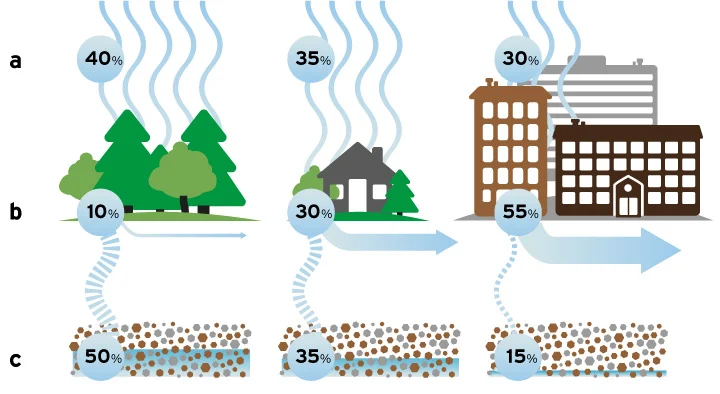
Today more than half of the world’s population lives in cities, and in 2050, the share of urban population is estimated to be almost 70% (Ritchie and Roser 2018). Urbanisation and dense cities lead to a lot of built, impermeable surfaces that strongly affect and change the natural cycle of water. A study of nine cities in the United States showed that the portion of land covered by impervious surfaces grows proportionally with the city growth (USGS cited in Malakoff et al. 2016). The frequency and intensity of heavy rainfall events have likely increased for instance in Europe (McSweeney 2021), and water-related hazards are expected to intensify along with climate change (OECD 2020). These are expected to exacerbate problems stemming from disturbing the natural hydrological cycle. One of them is stormwater, or urban runoff, i.e. rainwater or meltwater that is accumulated on soil surfaces, roofs of buildings and other similar surfaces in built areas. This differs from natural runoff that is runoff of water from unbuilt areas; stormwater is therefore characterised by the impact of human activities (City of Helsinki 2018, Ministry of Agriculture and Forestry 2001). Figure 1 shows how the impermeable surfaces affect the forming of stormwater.
Most of the urban stormwater management infrastructure existing in developed cities in Europe are based on the modern urban sewer systems built in the second half of the 19th century (Bertrand-Krajewski 2021). These systems have also been developed in climatic conditions that are different from today’s, calling for more climate resilient systems. Stormwater has traditionally been managed in urban areas with grey infrastructure, including directing the water as fast as possible away from paved surfaces through underground pipes into sewers and receiving waters. The drainage systems are not generally designed for heavy rainfall or cloudburst events. Therefore, flooding may occur and cause damage to buildings and other property.
In addition to the increased amounts of stormwater needing to be handled, also the quality has gained growing interest. Along with increasing urbanisation and impermeable surfaces, the quality of stormwater is worsening. While stormwater is generally not considered to include harmful substances in quantities that would cause actual environmental or health harm (compared to wastewater), there can still be risk factors like nutrients, solid matter, chemical residues and microplastics that can cause harm if they end up in waterways or soil (Gustafsson 2021).
Increasingly, integrated approaches to urban water management – that correct or mimic the natural cycle of water and utilise ecosystems’ functions – are emerging. These approaches can be called in various ways – such as blue-green infrastructure, nature-based solutions, sustainable urban drainage systems, ecosystem-based adaptation and water sensitive urban design.
Aims of the report
The main aim of this report is to identify good practices and solutions to green or nature-based stormwater management in urban areas, focusing on the Helsinki Metropolitan Area (HMA). This is to reduce negative impacts of stormwater on freshwater resources, targeted at the four land use types defined in the RAINMAN project (see Figure 2).
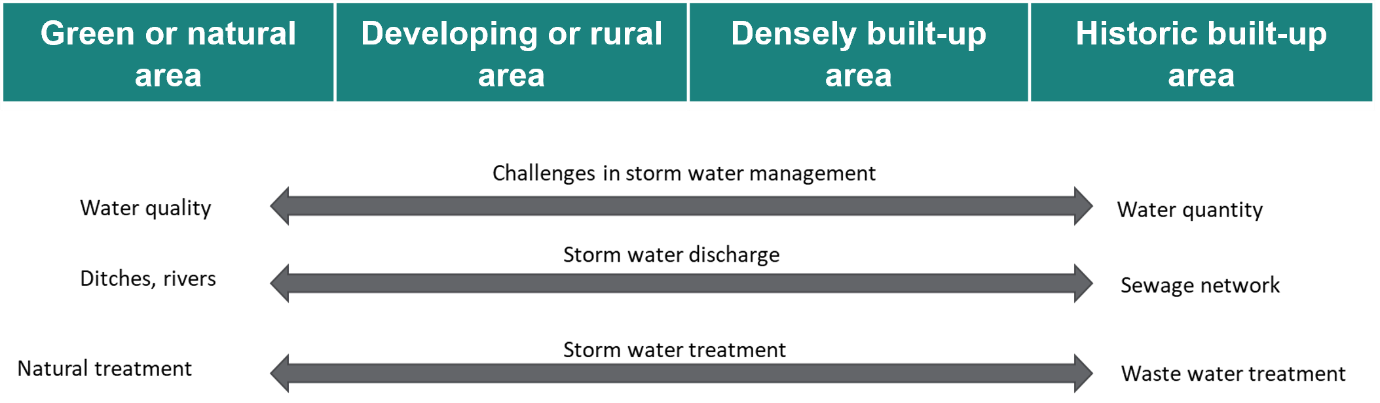
The RAINMAN project is based on an assumption that nature-based solutions can be easier to implement in developing areas but on densely built-up or historical areas novel solutions might not be possible to realise and traditional methods to handle stormwaters are more feasible. Therefore, a decision was made at the outset of the project to specify solutions for different land use types that have comparable characteristics in Finland and Russia. It was agreed to divide solutions in four different categories: green or natural areas, developing or rural areas, densely built-up areas, and historical built-up areas. Analysing similar land use types in the project case study areas enables sharing best practices and cross-border learning in common challenges.
The results of this work can benefit both the RAINMAN project partners as well as wider audience in other urban areas, especially professionals working on urban water management issues.
This report intends to respond to the following questions:
- How is a "green" or "nature-based" stormwater management solution defined?
- What are the good practices and solutions to stormwater management in the Helsinki Metropolitan Area’s cities?
- Are certain types of solutions favoured?
- Which kinds of solutions are planned at the moment?
- What are the co-benefits?
- How are these solutions monitored or maintained?
- What types of governance structures or strategies cities have have adopted or put in place?
- What factors have facilitated these solutions, and what obstacles still remain?
Chapter 3 provides a brief overview of concepts and definitions related to the stormwater management, and nature-based solutions especially in the stormwater management context. Chapter 4 introduces the Helsinki Metropolitan Area in the study context, while Chapter 5 presents the materials and methods used in this work. In Chapters 6-9, selected stormwater management solutions in the HMA are showcased. Chapter 10 discusses the findings, and Chapter 11 provides conclusions.